Every year as the summer comes to an end and school starts up, we all know that flu season is just around the corner. This year however, our annual flu season will start up amid the COVID-19 pandemic.
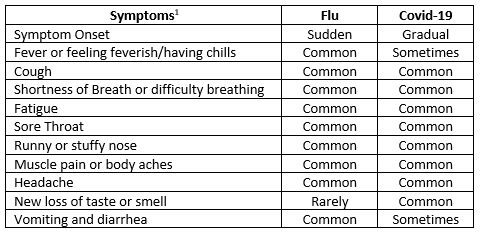
Most know that COVID-19 and the flu share a lot of the same symptoms, so how will we be able to tell the difference between COVID-19 symptoms and flu symptoms this upcoming flu season? Its going to be tricky.
Influenza and COVID-19 are both contagious respiratory illnesses that have some very common symptoms but can affect people differently. Compared to flu, COVID-19 appears to be more contagious, spreads quicker, can cause more serious illnesses, and can also take longer before people show symptoms.
The viruses that cause COVID-19 and the flu spread in similar ways. They can both spread between people who are in close contact (within 6 feet) through respiratory droplets or aerosols released through talking, coughing, or sneezing. These viruses can also spread if a person touches a surface with one of the viruses on it and then touches their eyes, mouth, or nose .
Because many symptoms of the flu, and COVID-19 are similar, the difference between them cannot be made based on symptoms alone; testing will be required to determine what the illness is and to confirm a diagnosis.
To help reduce your risk of the flu, individual should get the annual flu vaccine. The flu vaccine can reduce the severity of the flu and the risk of serious complications. Each year’s flu vaccine provides protection from the three or four influenza viruses that are expected to be the most common during that year’s flu season.
To help reduce your risk of COVID-19 the FDA has given emergency use authorization for vaccines in the United States. A COVID-19 vaccine can prevent you from getting the virus or prevent you from becoming seriously ill if you get the COVID-19 virus.
It is important to note that the flu vaccine doesn’t protect you from getting COVID-19 and the COVID-19 vaccine doesn’t protect you against the flu, so it is imperative to receive both vaccinations for the most effective coverage. It has also been discovered that people can be infected with both flu and the virus that causes COVID-19 at the same time and have symptoms of both influenza and COVID-19.
If you haven’t had the COVID-19 or flu vaccine, there are precautions you can take to reduce your risk of infection, maybe which the country has already adopted during the pandemic:
Taking these prevention measures can help you stay healthy and reduce your risk of becoming ill with COVID-19 or the flu.
Don’t let your guard down this year, get your vaccinations.
https://www.cdc.gov/flu/symptoms/flu-vs-covid19.htm
https://www.mayoclinic.org/diseases-conditions/coronavirus/in-depth/coronavirus-vs-flu/art-20490339
1 https://www.cdc.gov/flu/symptoms/flu-vs-covid19.htm